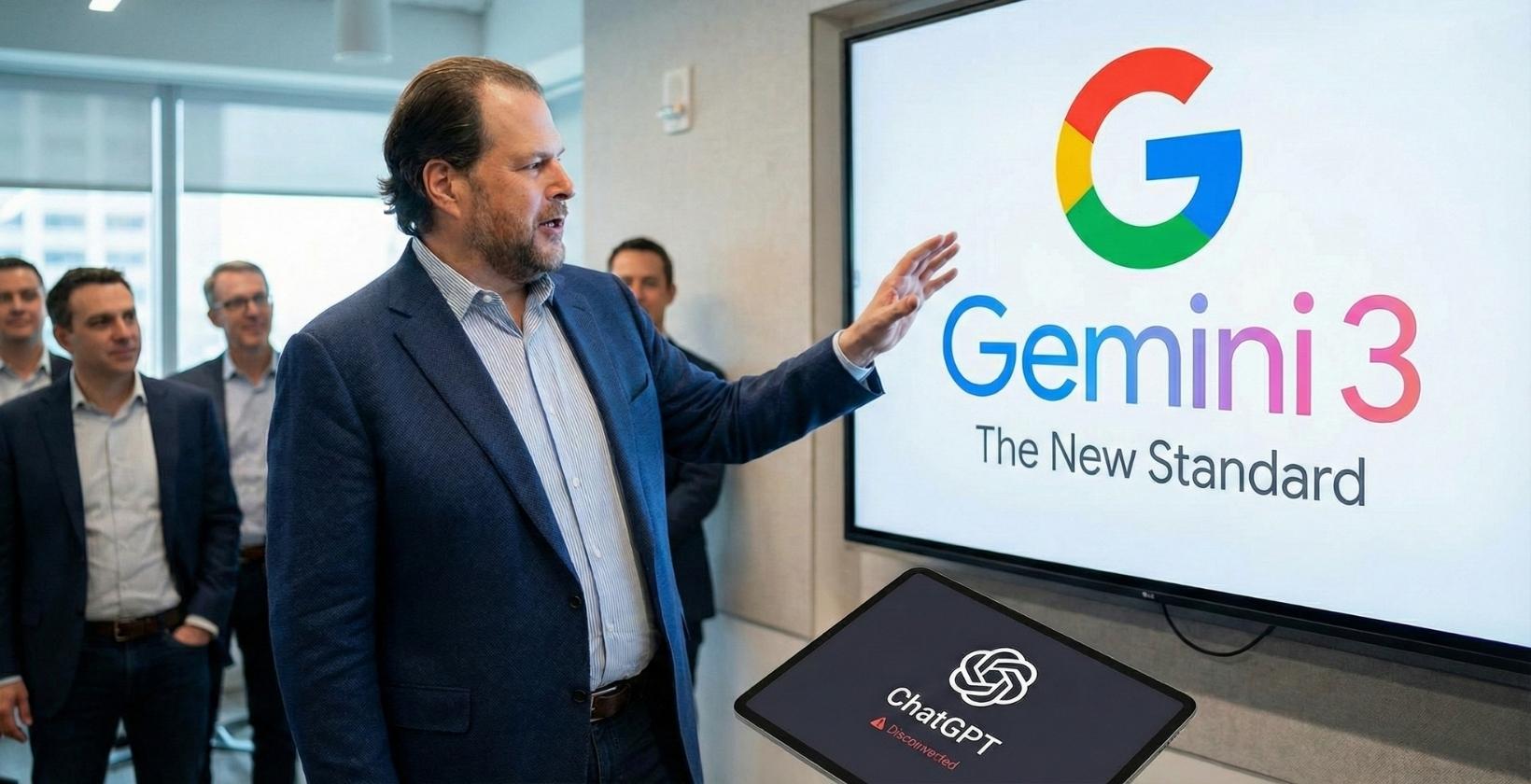
The narrative surrounding dominance in the generative AI space is shifting. While OpenAI’s ChatGPT has long held the position of the industry standard, often receiving the “verbification” treatment synonymous with searching Google, competitors are rapidly closing the gap. Following the release of Google’s Gemini 3, a growing cohort of high-profile tech executives, led by Salesforce CEO Marc Benioff, are publicly declaring a preference for Google’s latest model over the incumbent ChatGPT.
High-Profile Endorsements for Gemini 3
Marc Benioff, a long-time proponent of ChatGPT, recently took to X (formerly Twitter) to announce a significant change in his daily workflow. After three years of relying on OpenAI’s product, Benioff stated he is “not going back” after testing Google’s latest iteration.
“Holy shit. I’ve used ChatGPT every day for 3 years. Just spent 2 hours on Gemini 3. I’m not going back,” Benioff wrote. He described the upgrade in performance as “insane,” noting that “everything is sharper and faster.”
Benioff is not the only industry heavyweight favoring the new model. Andrej Karpathy, a former co-founder of OpenAI, described Gemini 3 as a “clearly a tier 1 LLM” and noted its viability as a “very solid daily driver.“
Similarly, Patrick Collison, CEO of Stripe, offered high praise for the release. Collison’s endorsement is particularly significant given Stripe’s existing strategic partnership with OpenAI to integrate AI-driven transaction features. The willingness of partners to publicly laud a competitor’s product highlights the undeniable technical leap represented by Google’s update.
Benchmarks and Reasoning Capabilities
The executive buzz correlates with data emerging from technical benchmarks. Google has aggressively highlighted Gemini 3’s performance across standard testing metrics, claiming top scores in nearly every category.
While synthetic benchmarks are often viewed with skepticism, independent evaluators are validating these claims. According to reports cited by Gizmodo, Wei-Lin Chiang, co-founder and CTO of the benchmarking firm LMArena, suggests that Gemini 3 is more than just a statistical improvement.
Chiang noted that the model illustrates a shift in the “AI arms race,” characterized by models that can:
- Reason more abstractly.
- Generalize more consistently.
- Deliver dependable results across diverse real-world evaluations.
Pressure Mounts on OpenAI
The resurgence of Google in the AI sector introduces complex challenges for OpenAI. The company is currently navigating scrutiny regarding its path to profitability amidst massive infrastructure spending.
Historically viewed as the undisputed innovator, OpenAI now faces a competitor with significantly deeper financial reserves. Google’s ability to outspend rivals on data center expansion and R&D without the same immediate profitability concerns poses a threat to OpenAI’s market share. As Gemini 3 gains traction among the C-suite and power users, the perception of OpenAI as the sole leader in the generative AI economy is being actively tested.